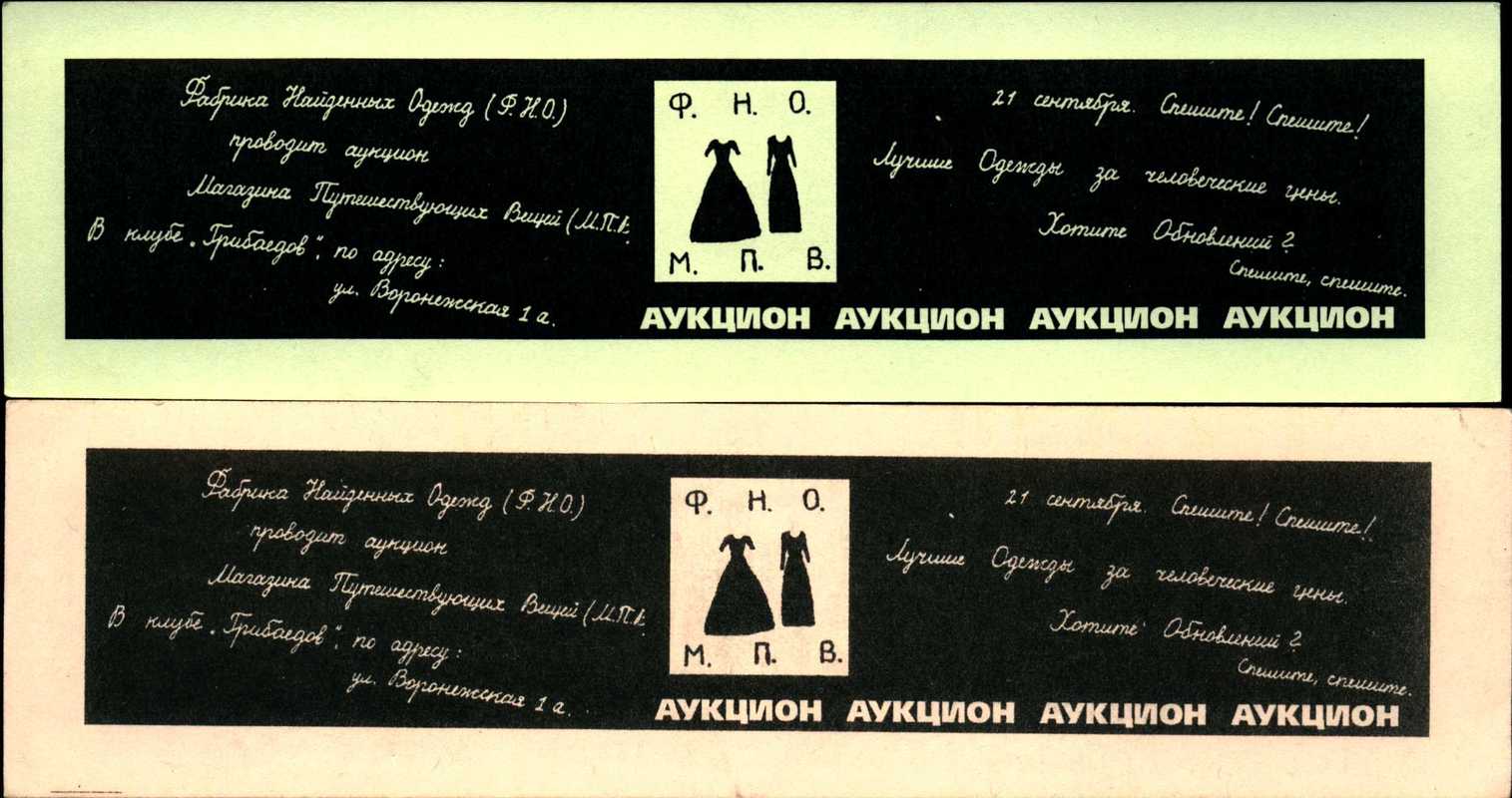
St. Petersburg-based artists Olga Egorova (Tsaplya) and Natalia Pershina-Yakimanskaya (Glyuklya)[1] founded the group Factory of Found Clothes (FFC) in 1995. Garage Archive Collection contains a clipping with an interview, in which Glyuklya recalls meeting Tsaplya. “We met at [Sergei] Denisov’s studio and became friends. During the tough years of perestroika, I painted on silks and we wandered the city with them. Imagine this: we ran into banks and offered their staff to wrap our silks around their cash machines. Tsaplya spoke to them in the voice of a museum guide. ‘This, before your eyes, is a work of art!’ she’d say. ‘If you think these are mere clothes, you are very wrong! This is a real art work! This is not just a scarf! This is a scarf-object!”.[2]
Glyuklya and Tsaplya shared an interest in clothes as an artistic medium, and from the very start of their joint career they performed “romantic artistic feats.”[3] In Appeasement of the Neva (1996), the duo threw clothes into the river from a helicopter, and in the well-known performance In Memory of Poor Lisa (1996),[4] they jumped into the river themselves while holding a black dress as a tribute to “those who have known the suffering of love.”[5] The project Héloïse and Abelard, or Five Feats of a Submarine (2000) took place on a warship, and in Immersion (2002) they dove to the bottom of a river with scuba sets. During their career as a duo they challenged forces of nature and boundaries (sometimes literally, as in their action Illegal Crossing of the Border Between the Czech Republic and Germany in 1997) to build a utopian universe where clothes had agency.
A factory is a system of buildings, workshops and spaces, and the world of FFC was organized in a similar way, with material production replaced by the production of art. Circulating around the creative workshops of Glyuklya and Tsaplya’s Factory, clothes became more than mere utilitarian objects. The two key institutions the duo created were the Shop of Traveling Things (STT[L1] ) and, later, the Shop of Utopian Clothes (SUC[L2] , or FFC and Friends). There, Glyuklya and Tsaplya invented ways of sending clothes to travel to the outside world, using a variety of tools. Their production of alternative institutions is discussed below: our research focuses specifically on the Shop of Traveling Things and related projects.
The Shop of Traveling Things, 1994–2000
Factory of Found Clothes started their joint career with the launch of the Shop of Traveling Things in 1994. The STT was at the root of their institutional critique, reflecting the ambition to reinvent social structures—a task that occupied FFC throughout their career. The Shop opened as Olga Egorova’s project at Gallery 21[6] at the art center Pushkinskaya-10. While Tsaplya was opening the shop, Glyuklya made silk works: she joined the project later, when the two formed a group. “We kept coming up with various games. In the 1990s, it was in the air—play was in everything. As FFC, we joined forces and invented names for our games. Our work became more purposeful. We liked thinking of it as a well-organized daydream, where the Grammar-School Girl[7] ruled and there was no death,”[8] Tsaplya recalls.

STT emerged in the era of thrift stores and the heyday of St. Petersburg dandy culture, with its love for carnival. In those years, tailor Konstantin Goncharov was running his famous atelier Strogii Yunosha [Strict Young Man]. Art was seeping into all areas of life. FFC’s shop, however, stood apart due to its radical approach: more than a display of aesthetic objects (although they were often luxury garments made for a narrow circle of customers), it was a manifesto that facilitated romantic adventures for clothes. “A garment is born and, by traveling the path of suffering and losses—the loss of buttons, the replacement of collars—it gains a will of its own,” Tsaplya explains. “You could see it as a reference to Bruno Latour’s Parliament of Things,[9] but in fact the Shop opened before Latour’s text was published. We were interested in the horizontal movement of clothes and how they assembled themselves into collages.”[10]
The description of the shop specified that it was a “space inhabited by liberated clothes,” where the staff “observed the movements of freely travelling garments” which had previously been “lost in markets and thrift stores.”[11] The task of the duo was to study the forming of each item’s individuality through the documentation and interpretation of their travels, understood as “lived experiences.”
At the Shop, garments received a name, a “passport” (47 such passports have been published on RAAN), and an “understandable story, comforting to a human”[12]— in other words, a biography[13]—which the duo wrote in a free, often poetic form. There, they noted changes in its physical state and location, forming the item’s unique history. For example, the biography of a “green jumper with an acrylic landscape” looks like a list of phenomena of the outside world that together create a pastoral scene: “the sun, a bird, the sea, trees, fish.”[14]
To every item Tsaplya and Glyuklya attached their own label. “Two little dresses and ‘FFC’ written next to them. It was a work in its own right. Even today people find these labels and tell us. The clothes are still traveling, going in circles. They carry this mark like a bird carries a ring,”[15] Olga Egorova says. The label not only marked the garment’s involvement in the project but also acted as an “indicator” of its movements, extending the project beyond its completion.
Stories of owning a garment were a form of capital: they could be exchanged for items of clothing. Customers could also simply exchange old garments for new ones or buy items for money. Prices were low but helped support the Shop, which, in economic terms, was a grassroots initiative driven primarily by the duo’s enthusiasm. “People often invited me to look through their grandmother’s suitcases. I saved cheap old garments from oblivion in markets and reconstructed them. I altered them slightly, making them really quite attractive. But it was important to me to not change them into objects. They came to me and I had the right to help them move on but not to turn them into objects! Otherwise, their journey would end. Glyuklya’s approach was different, so the Shop also featured her objects. Sometimes I
also allowed more significant transformations,”[16] Tsaplya recalls.
An important aspect of their work that manifested itself in the early years was healing, or therapy. “The life of a traveling garment is full of suffering and losses. At the shop, they acquired pretty new buttons, collars, and patches; the ones whose stories really stood out received medals and letters, including love letters.”[17] The reconstruction of a garment at the Shop was seen as its healing. The process of reconstruction was documented in the Catalogue of Samples of Clothes Striving for Perfection. Later, healing became one of the central themes in the work of the duo.

In the FFC universe, garments became emancipated agents. Being free meant being able to move freely, and the artists created for clothes an accessible environment that provided such an opportunity. The task of the “protagonists” (particular dresses and other garments) was to push themselves, overcoming external obstacles, in order to recreate themselves. Their journey was understood as a heroic feat, an act of transformation from a utilitarian object into an individual. A garment could travel with the artists to Crimea, as in the project Sacrifice of the Dress (A Russian Novel) or return to the previous owner after being fixed at their G.I. Gurdjieff Universal Shop of Clothing Repairs. Like an art travel agency, the Shop of Traveling Things moderated their journeys, thinking of further points of departure and migration routes to the outside world. The first such point was an auction, where clothes “departed on a journey” with new owners.
Girlfriends, 1995
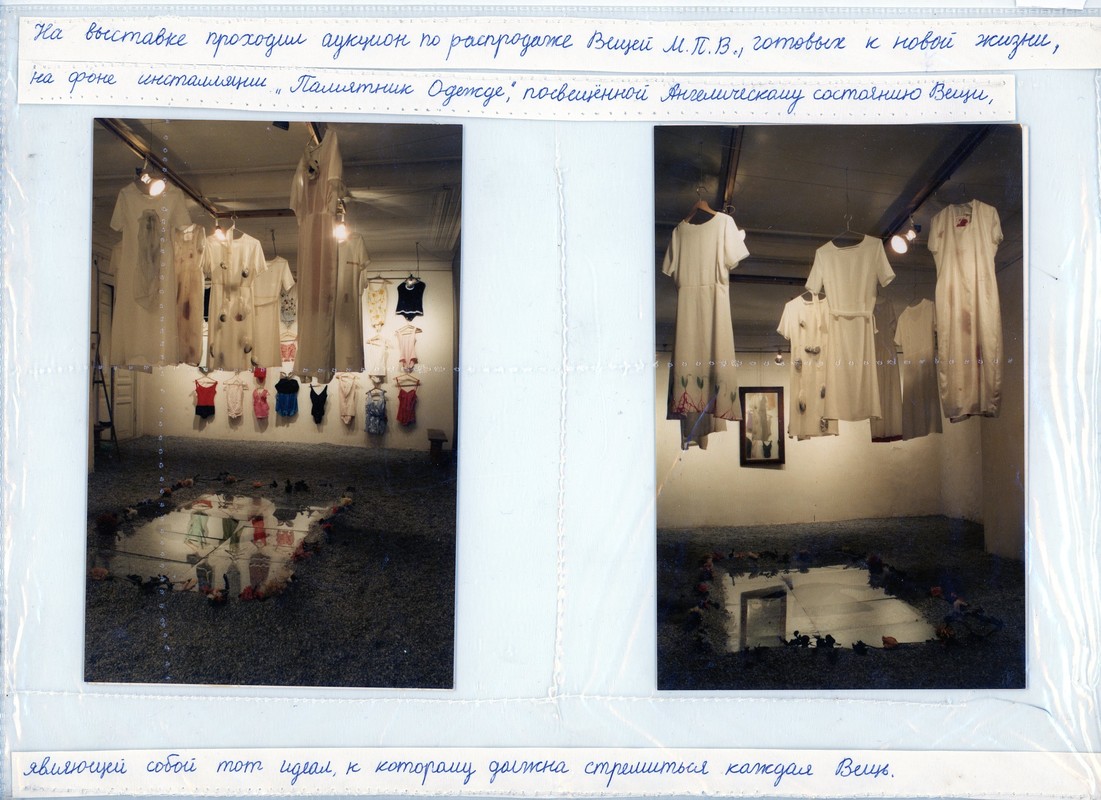
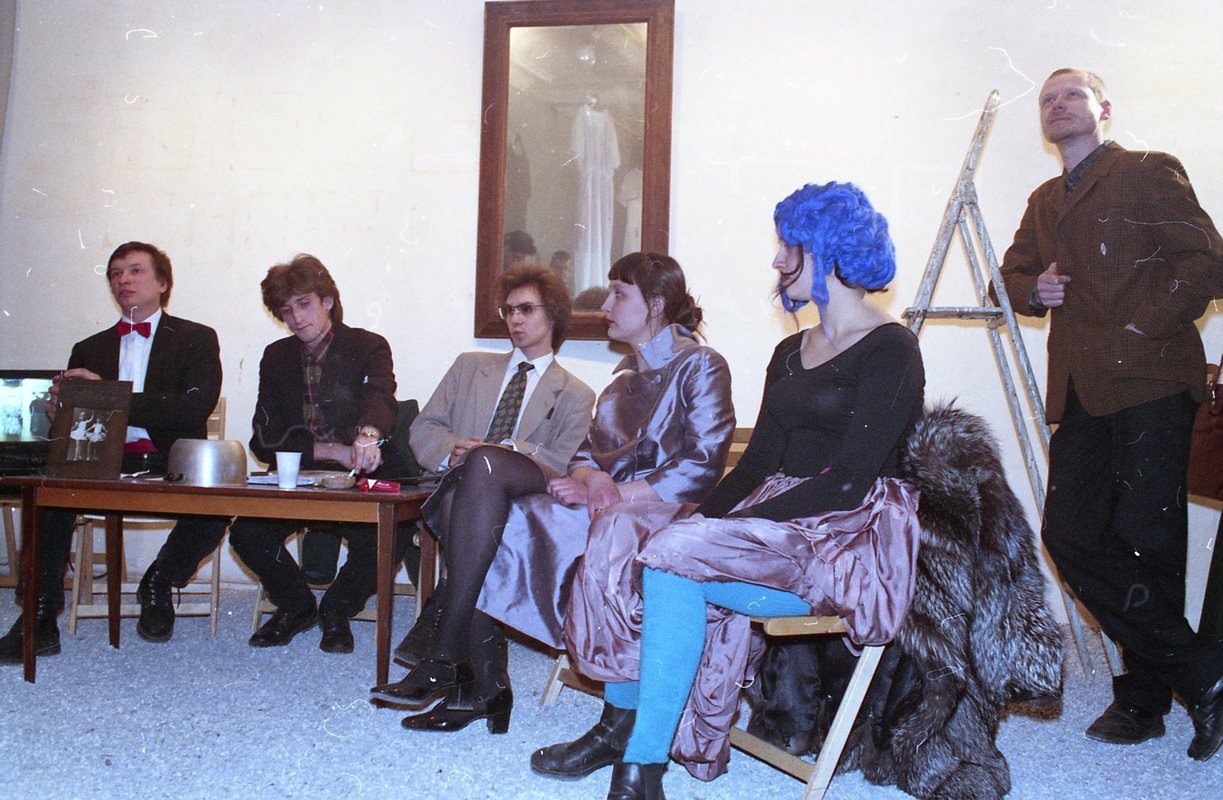
FFC’s first exhibition, Girlfriends, took place at Gallery 21, where the Shop of Traveling Things was still operating. At the preview of the “auction-exhibition”[18] on April 2, Glyuklya and Tsaplya held a public discussion about FFC and their relationship with clothes. The discussion was moderated by artist and curator Dmitri Pilikin. During the exhibition there was a public auction, with artist and art historian Andrei Khlobystin as auctioneer. Glyuklya and Tsaplya’s friends (such as artist Babi Badalov) wore the lots in a fashion show. During the auction, the Engineering Theatre AXE organized a performance. “They were frying something on a dress,”[19] Olga Egorova recalls.

The description of the auction-exhibition stated, “We are friends and, apart from being soulmates, we are united in our attachment to Things, and in particular, to their most human form: Clothes. We are different, so we express our passion differently. We like the differences between us, because they bring with them the complexity of reflections. The exhibition we have made comes from an ambition to bring together two perspectives on the existence of things, to erect a monument to them. Mutual reflections is what the project is obsessed with, so the most natural form for it, we believe, is a dialogue or, to be more precise, a conversation between two girls.”[20]
FFC’s first exhibition reflected their interest in the “immaterial” aspect of clothing: the transition of clothes to a different status and a different state, including the afterlife, as in Monument to Clothes, which shown in the exhibition. In the installation, which had a grave at its center, dresses were shown as approaching an “angelic state.” In their description of the project, Glyuklya and Tsaplya also spoke of clothes’ attraction to the otherworldly and their “favorite state”(between life and death); they told stories of dandies, who used to “wipe their tailcoats with a shard of glass before putting them on, until it became a sort of lace or cloud,” and discussed the function of the artist, who removes “the cover of functionality from a garment, relieving it of its ‘thinghood’ and giving it a chance for a new evolutionary transformation. It is as if they were making a plant into a fish.”[21]
Sacrifice of the Dress (A Russian Novel), 1995
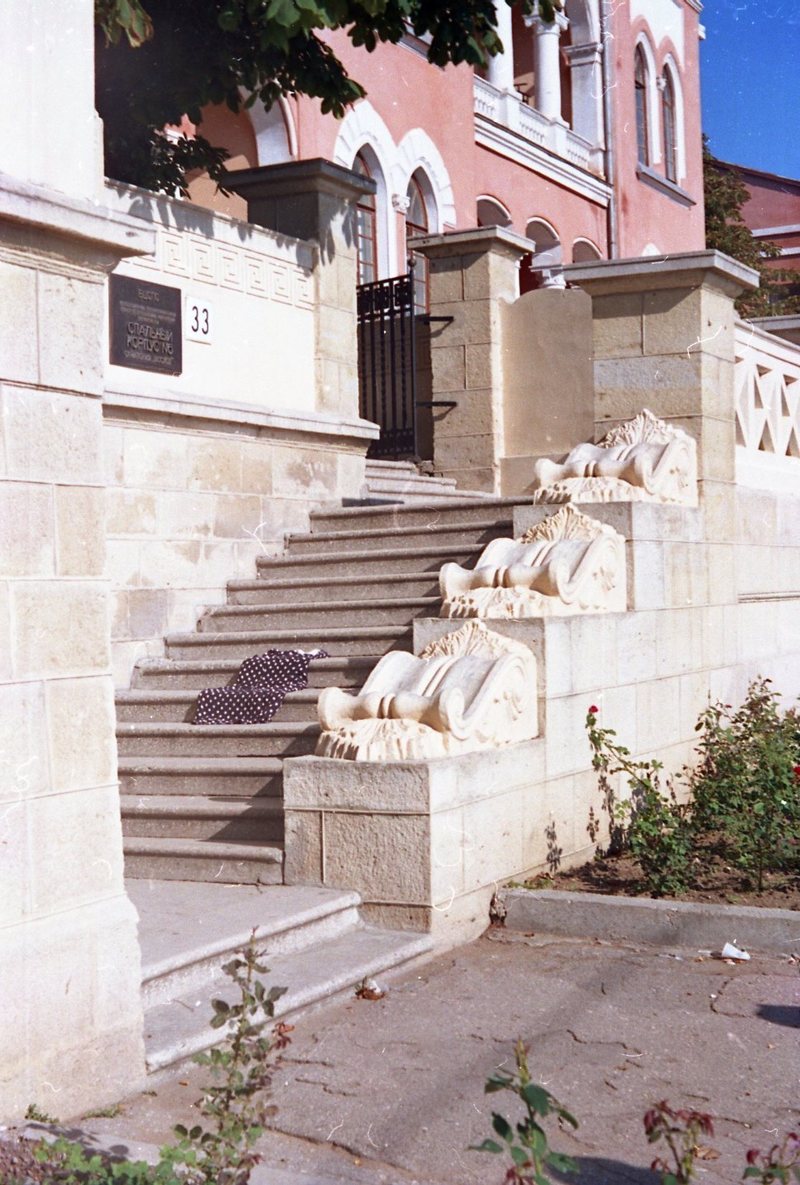
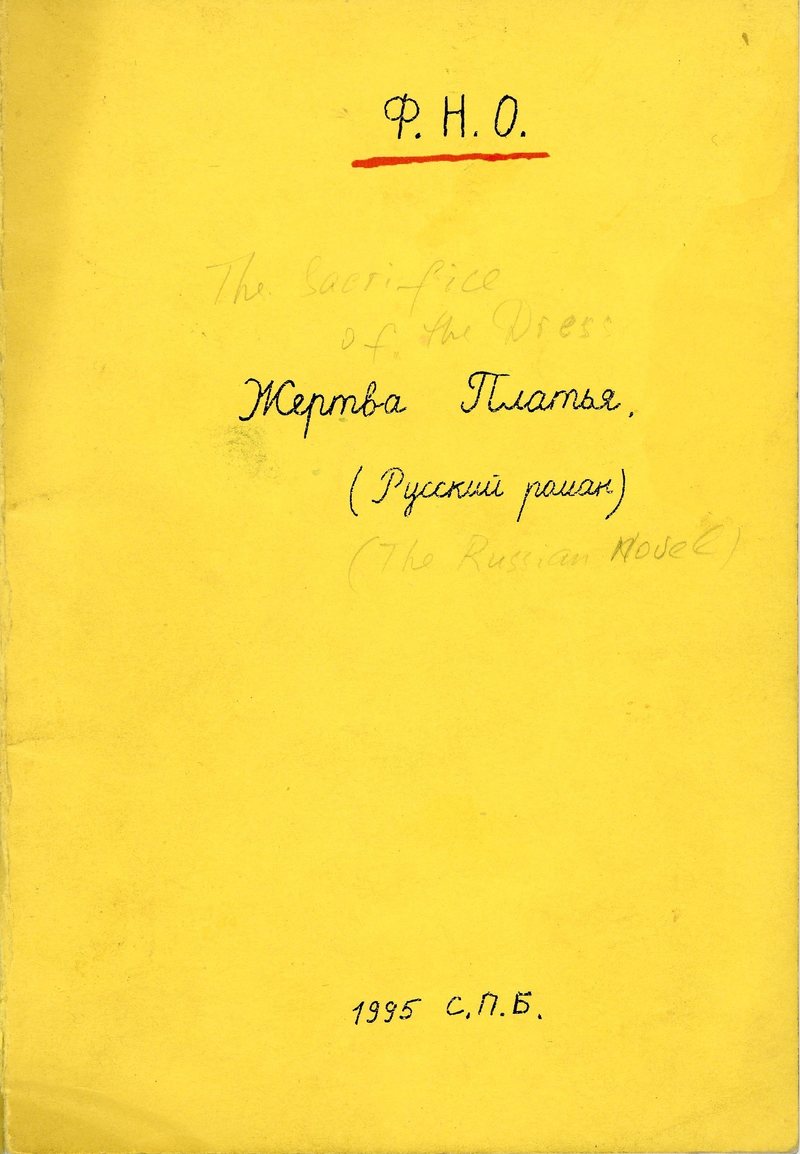
The project that followed, Sacrifice of the Dress (A Russian Novel), opened up new travel routes for clothes. It included a one-day exhibition, a performance, and an artist’s book, which also explained the idea of the project. “This book contains documentary evidence of the life of one dress,” it says. “Unwanted, lost, and exhausted, it came to the Shop of Traveling Things from an old market in St. Petersburg. Filled with compassion and pity, we, as its new owners and patrons, took it to the sea. This is how the Crimean journey of the Dress began, which proved to be the most significant episode in its biography.”[22]

The life of the Dress became a literary novel: making it a literary protagonist helped personify it. The first part of the book consisted of Glyuklya and Tsaplya’s observations on the Dress and the second presented the Dress’s own travel notes. The duo’s part of the story was organized as photographic report, which revealed in detail the itinerary and the movements of the Dress, with captions such as “The Dress at Maximilian Voloshin’s grave;” “The Dress is hiding in the changing room and watching seagulls so as not to scare them away;” “The Dress is in despair after finding the Alexander Grin Museum closed.”[23] On its journey, the Dress enjoyed a fizzy drink, worshiped Aphrodite, dreamt of becoming a nymph, and visited princesses.”
“The Dress chose its itinerary itself and we followed it and indulged it in everything. The Dress wanted to feel romantic and we took it to watch the stormy sea. It wanted to suffer, and we left it on the sand to be torn up by seagulls. It wanted a lot. It was building its best body of rapture, whims, infatuation, and passion. It wanted to love, to humiliate itself, to watch the procession of celestial bodies, and we did everything to satisfy its every wish,” Glyuklya and Tsaplya wrote.[24]
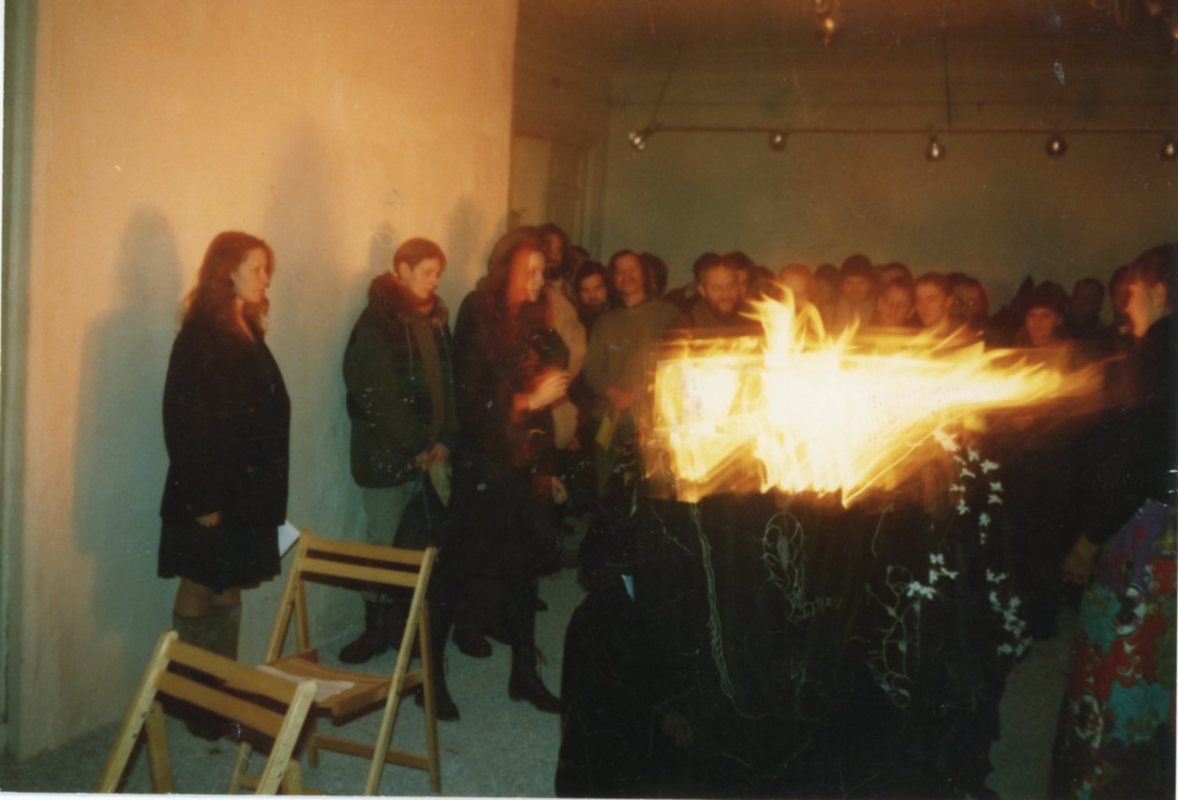
The project culminated in a one-day exhibition at Gallery 21, where the duo burned the Dress during a performance. “Over the course of our travels, we had gotten attached to the Dress,” the duo confess in the novel, “but we were haunted by a strange feeling. Its independence was torturous, as love can be sometimes. And there was only one way of getting rid of this obsession: to give the Dress to the purifying fire and release whatever was hiding inside.”[25]

Glyuklya and Tsaplya explained their gesture as follows. “When we brought the Dress to St. Petersburg, it turned out we could not do anything with it. We could not wear it and we could not sell it. During the journey, it became very full. We had this illusion that it had grown a body of its own. We had loaded it so heavily with our own desires that you could not put an arm through it. So, we decided that the only solution was to burn the Dress and liberate it.”[26]
The dress was given to fire—it no longer belonged to a human, nor to this world, but was transferred to the unearthly realm. In this context, the sacrifice was understood both as an element of the literary romantic canon, according to which the protagonist had to die, and a sacred ritual of liberation from human power. For Glyuklya, the project also “developed in parallel to a real-life drama and a break-up of a relationship,” which made the performance a therapeutic gesture.
G.I. Gurdjieff Universal Shop of Clothing Repairs, 1999–2000
The last project of the Shop of Traveling Things was the travelling G.I. Gurdjieff Universal Shop of Clothing Repairs. On March 13, 14, 20, and 21, 1999, it opened at Mitki-VKhUTEMAS Center for Creativity, and later popped up on several occasions at the Shop (at Gallery 21) until the Shop’s permanent closure.

“George Ivanovich Gurdjieff is a Hero for our Factory of Found Clothes,” explain Glyuklya and Tsaplya. “A philosopher and a mystic; a Teacher, whose ‘voice sounded like a call,’ he was an enigma who knew how to organize miracles, adventures, and various incredible events. But most importantly, Gurdjieff developed a new (for his time) relationship to things and opened something of an experimental lab that worked according to his principles. He also proved to be a Great Ruler of Things.”[27]
According to legend, Gurdjieff opened his first mobile shop where he repaired anything and everything to earn money for a journey to the Gobi Desert.[28] At his repair shop, which popped up in various settlements for brief periods of time, Gurdjieff looked for a unique approach to every single object. Inspired by his example, FFC started their own repair shop that adhered to the fifteen main principles that Gurdjieff suggested in 1899.
Here are some of them:
- pure intentions;
- the Repair Shop emerges where it is needed;
- the Repair Shop never refuses to help;
- at the Repair Shop, things reveal their secrets;
- the Repair Shop makes unwanted things wanted again;
- cooperation of friends and educating the youth;
- changes in the body created by the working of the shop.[29]
The duo took different jobs in the Repair Shop. Olga Egorova (Tsaplya) worked at the front desk, while Natalia Pershina-Yakimanskaya’s job title was “Snow Queen.” FFC’s friends who took part in the work of the shop included Valentina Shchekina as “Master of Blue Warts,” Valentina Katagonova as “Master of Velvet Patches,” and other participants listed as “grammar-school girls from nice families.”[30]
“It was a proper repair shop where people brought their clothes. First, they came to me at the front desk, where I sat in a black dress with a white collar. I interviewed them in detail about their relationship with the thing. For example, Edik Shelganov[31] would come and say, ‘A hole keeps appearing in the pocket of my coat.’ Then, I would find out that the key from his house kept falling out of it. So, the hole was a manifestation of his homeless spirit,” Tsaplya recalls.[32]
The Repair Shop staff diagnosed the garment after a conversation with its owner and prescribed treatment, thus personifying each item. Bitter feelings required plum jam; for extreme openness a secret pocket would be attached on a hook-and-loop fastener; little whims of a gown were to be indulged; and if the garment was becoming increasingly cheeky, little pointed beads were sewn on. FFC reinterpreted Gurdjieff’s project in their romantic terms: the “changes in the body” in their case referred to the body of the garment, and therapy involved psychological changes in the owner. The Repair Shop became a psychoanalyst’s consulting room for things and their owners.
The Shop Closes
Glyuklya and Tsaplya’s work was concerned with transcending the limitations of the real and moving toward the sublime and utopian worlds. Their approach could be defined as romantic transgression: an overcoming of physical and geographical boundaries and their own limitations thorough artistic “feats.” If in performances the artists explored personal and outer limitations, the Shop’s work was focused on the limitations of the thing: who has power over it and to whom does it belong? To a person, to the realm of art as an object or to the cosmic organization of the world?

The Shop of Traveling Things existed until 2000. Neither Tsaplya, nor Glyuklya remember when exactly it came to an end. According to Egorova, she lost interest in it. “It was the year 2000, a new century, and you just dressed differently. I shaved my head and wore regular jeans and a polo shirt.”[33]
The group continued to work together. In 2004, the Shop of Utopian Clothing (2004–2010) became their new landmark project, initiated by Glyuklya. The two institutions reflected different artistic approaches. The STT, started by Tsaplya, was a platform that responded better to her artistic vision, while the SUC created by Glyuklya focused less on the thing itself and more on the human stories behind it. The main innovation in the second institution was its focus on open collective work: meetings were organised as workshops that anybody could join. This project by the FFC is currently awaiting its study, which will allow to produce a detailed account of the Shop of Utopian Clothing based on the Factory of Found Clothes archive in Garage Archive Collection.
[1] Glyuklya explains that her artist’s name dates back to her childhood and connects it to an episode when her father told her a joke about a soldier who spent all his time in service doing some kind of “glyuklya,” [a word that in Russian sounds like a feminized version of “glyuk” meaning “glitch” or “hallucination”] . A version of the joke can be found on the Internet, where the soldier is busy building a “glyukalo” that makes a noise described as “glyukanie.” In online dictionaries, “glyukalo” is defined as an object of unclear, unknown purpose. Tsaplya’s [Heron] artist name appeared later as a rhyme to Glyuklya’s. Their choice of artist names also addresses the gender bias: Glyuklya remembers that in one interview she gave, she “wanted to be a crocodile and not a girl.”
[2] E. Trofimova, “In Dress We Trust,” Gaudeamus, April 2004. Garage Archive Collection (Irina Aktuganova and Sergey Busov archive), IA-CFC-IV-L34903.
[3] This formula describing the duo’s performances reflects their interest in the sublime and the utopian. The characters from FFC performances had historical or literary prototypes (Grammar-School Girl, The Whites, Princess of Scotland, High Priestess Pythia, Assol, Poor Liza, Ophelia, Zoya Kosmodemyanskaya, Joan of Arc), which also points to the romantic origins of their art and an interest in the phenomenon of the heroic feat. “The main idea is the adventure of a romantic hero,” Glyuklya explained in an interview. The performative state is all about feeling like a hero—an intelligence officer on an important mission. The hero always has to overcome fear.” (see Артюх А. Глюкля и Цапля: «Преодолевать страх — это мы любим!» // Искусство кино. URL: https://old.kinoart.ru/archive/2008/08/n8-article21)
[4] According to the artists, In Memory of Poor Lisa took place earlier, in 1995. The archival documentation is dated 1996, which Glyuklya and Tsaplya believe to be a mistake.
[5] Description of the performance In Memory of Poor Lisa by Factory of Found Clothes. Garage Archive Collection (Factory of Found Clothes (FFC) archive), FFC-PBL.1-D9965.
[6] A gallery in St. Petersburg active 1994 –2000.
[7] Grammar-School Girl is one of the central characters in the FFC universe. As researcher Maria Udovydchenko (Vovchic) points out, “the image of Grammar-School Girl reflects a historical type that existed in St. Petersburg in the years before the Revolution [Гимназистки в поисках подвига // Птюч. 1998. № 2. С. 70] and represents the most strange, capricious, and contradictory part of our soul, where fatal passions coexist with tenderness and timidity. She likes bead embroidery as much as she does the “blue steel of the revolver.” The duo believe that a grammar-school girl lives in every one of us and that accepting her as part of ourselfes can become a source of freedom and joy that are necessary to create ‘A Beautiful Dream that can Overcome Death.’” See Удовыдченко М. Памяти бедной Лизы // RAAN. 1 декабря 2021. URL: https://russianartarchive.net/ru/research/in-memory-of-poor-lisa.
[8] From an unpublished Interview with Olga Egorova (Tsaplya), November 11, 2024. Yana Nokhrina Archive.
[9] Философская концепция об агентности нечеловеческих существ. См.: Латур Б. Политики природы. Как привить наукам демократию. М.: Ад Маргинем Пресс, 2018. С. 335.
[10] Interview with Olga Egorova (Tsaplya).
[11] Description of the project Shop of Traveling Things by Factory of Found Clothes. Garage Archive Collection (Factory of Found Clothes (FFC) archive), FFC-MPV.1-D13449.
[12] Ibid.
[13] Some are part of Garage Archive Collection.
[14] Biographies of things from the project Shop of Traveling Things by Factory of Found Clothes. Garage Archive Collection (Factory of Found Clothes (FFC) archive), FFC-MPV.39-D13552.
[15] Interview with Olga Egorova (Tsaplya).
[16] Ibid.
[17] Description of the project Shop of Traveling Things by Factory of Found Clothes.
[18] Description of the exhibition-auction Friends by Factory of Found Clothes. Garage Archive Collection (Factory of Found Clothes (FFC) archive), FFC-P.1-D9938.
[19] Interview with Olga Egorova (Tsaplya).
[20] Description of the exhibition-auction Friends by Factory of Found Clothes. Garage Archive Collection (Factory of Found Clothes (FFC) archive), FFC-P.1-D9938.
[21] Ibid.
[22] Егорова О. Л., Першина-Якиманская Н. В. Жертва Платья (Русский роман). СПб.: Ф.Н.О., 1995. Архив Музея современного искусства «Гараж», фонд группы «Фабрика Найденных Одежд» (ФНО), шифр FFC-ZP.3-L47235.
[23] Ibid.
[24] Ibid.
[25] Ibid.
[26] Olesya Turkina’s interview with Olga Egorova and Natalia Pershina-Yakimanskaya: Динамические пары. К 10-летию Галереи Гельмана: Сб. интервью. М.: Галерея Гельмана. 2000. P. 124.
[27] Description of the project G.I. Gurdjieff Universal Shop of Clothing Repairs. Garage Archive Collection (Factory of Found Clothes (FFC) archive), MPV.56-D13639.
[28] The detailed story of Gurdjieff’s repair shop can be found in his autobiographical book Meetings with Remarkable Men.
[29] Description of the project G.I. Gurdjieff Universal Shop of Clothing Repairs. Garage Archive Collection (Factory of Found Clothes (FFC) archive).
[30] Ibid.
[31] St. Petersburg-based parallel cinema filmmaker Eduard Shelganov.
[32] Interview with Olga Egorova (Tsaplya).
[33] Ibid.
[L1]M.P.V., MPV? («М.П.В.» или МПВ
[L2]М.У.О.», МУО
[L3]Or girlfriends подруги